
One of the easiest traps in demand generation is declaring victory too early. The campaign launched. The leads arrived. The CPL looks reasonable. Everybody moves on. But that’s not optimization. That’s delivery.
The Citrix demand-generation reporting illustrates why one of the most important parts of growth is what I call Tune.
Start with the funnel
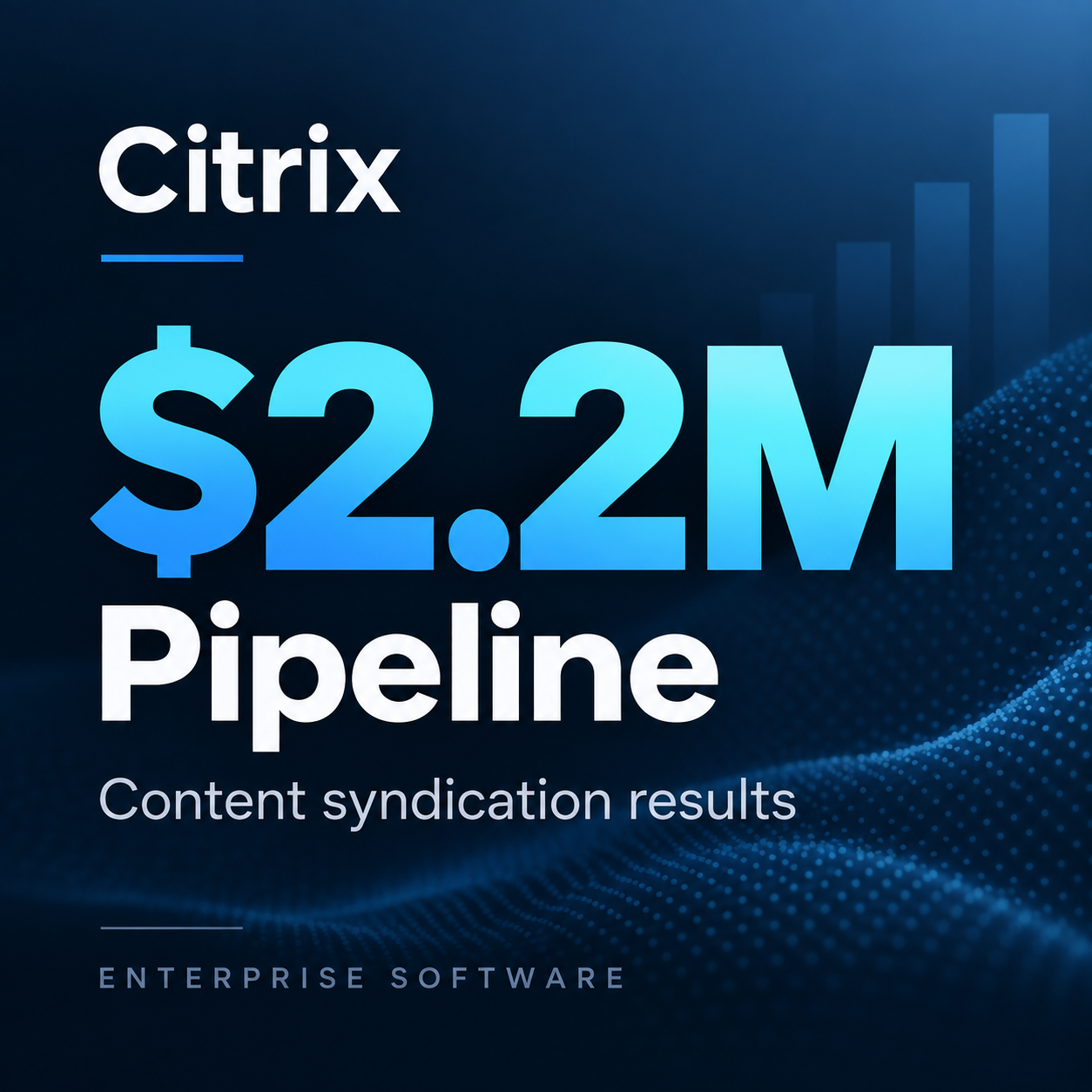
In one Q1 2017 Citrix WSS outbound program, the campaign generated 3,149 leads, 223 MQLs, 19 opportunities and approximately $2.21 million in opportunity value. Average CPL was $40.45 on approximately $127,000 of investment.
Those are strong reporting metrics. But the part of the report I find more interesting is what happened underneath the totals. Different partners performed very differently. One generated opportunities most efficiently. Others generated more MQL volume. Another was identified as the weakest overall performer. That’s where strategy starts.
CPL is not the finish line
Imagine two programs. Program A creates leads for $30. Program B creates leads for $45. If you stop there, Program A wins. But what if Program B creates twice as many opportunities? What if its opportunities are larger? What if its prospects convert faster?
Suddenly the expensive lead isn’t expensive. And the cheap lead isn’t cheap. This is why I don’t like optimization systems that stop at media efficiency. The right question is what business behavior the spend created.
Citrix was evaluating partners against MQLs, opportunities and spend per opportunity, not simply raw lead delivery. That creates a far more useful feedback loop.
This is Tune
My Growth Framework includes Tune because growth rarely happens exactly according to the PowerPoint. Markets respond. Campaigns behave differently. Creative fatigues. Intent shifts. Partners underperform. A channel that looked fantastic six months ago suddenly gets expensive.
Tune means treating the GTM system as something dynamic. You observe, learn, reallocate, test and repeat.
There’s another Walking the Dogs analogy here. Dusty and Tanner rarely walk exactly according to my original plan. Somebody stops. Somebody sees a dog. Somebody discovers what is apparently the most important bush in Northern California. The destination may remain the same. The route gets adjusted. Marketing needs the same flexibility.
Reporting should answer “what next?”
The best campaign report should not conclude with “here are our results.” It should conclude with “here’s what we’re changing because of the results.”
Citrix’s reporting called out which partners generated opportunities efficiently and which were weaker. Other campaign sections also documented what was working, what wasn’t, and what should change in the next quarter. That is an operating system: data, insight, decision, action.
The VP-level difference
A campaign manager can report CPL. A growth leader needs to decide whether to spend more, spend less, change the mix, change the audience, or rethink the offer. Is the problem media, messaging or product-market fit?
That is why Tune sits late in my Growth Framework but never really ends. You Gauge. Reframe. Orchestrate. Work the Plan. Then reality shows up. Tune is what you do next.
Growth Framework connection: Tune.
Walking the Dogs connection: The destination can stay fixed even when the route has to change.
These posts are part of the Growth in Practice series.
These five cases span very different companies, markets and stages of growth. But the pattern is remarkably consistent. Gauge reality. Reframe the market and goal. Orchestrate the buying journey. Work the Plan. Tune to market behavior. Harvest what works into a repeatable growth system. That is my G-R-O-W-T-H Framework.