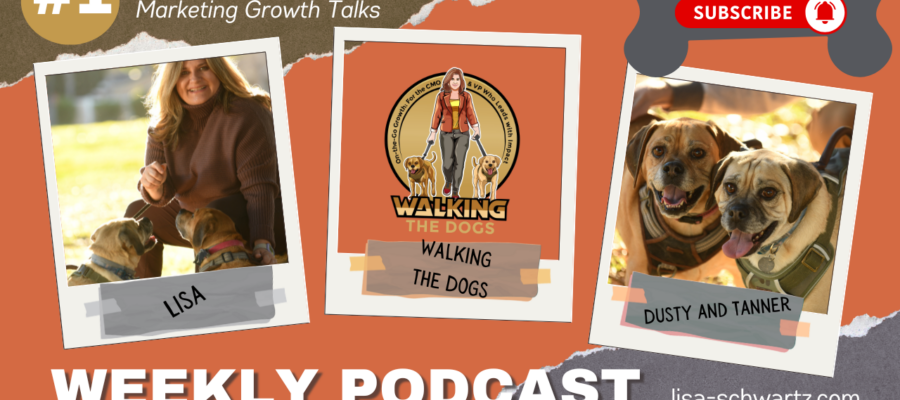
Chasing CAC? You Might Be Walking the Wrong GTM Dog | Walking the Dogs Ep. 1
Business question: How can leadership reduce customer acquisition cost without chasing the wrong growth motion?
Leadership takeaway: Choose a go-to-market path that fits the customer, offer, and capacity before optimizing CAC.
Framework fit: Win. Focus growth effort on the motion that can consistently win the right customers.
Related article: This post is the article.
Chasing CAC? You Might Be Walking the Wrong GTM Dog | Walking the Dogs Ep. 1
Most SaaS companies don’t actually have a customer acquisition cost problem.
They have a motion problem.
That’s a statement I know can make some marketers uncomfortable because when CAC starts creeping upward, the instinctive response is often tactical.
“Let’s shift budget from LinkedIn to YouTube.”
“Google CPCs are too expensive.”
“Organic should lower acquisition costs.”
“Maybe we just need more SDR activity.”
I understand why.
Boards are watching efficiency.
Founders are watching burn.
Marketing leaders are under pressure to justify spend.
Everyone wants to discover the magical channel where leads are plentiful, buyers are qualified, and acquisition costs magically decline.
But after working with SaaS organizations ranging from $20M to $50M ARR, as well as growth businesses inside larger enterprises, I’ve learned something important.
Companies rarely lower CAC by changing channels.
They lower CAC by aligning growth motions.
Dusty, Tanner and the Wrong Trail
On my Walking the Dogs podcast, I often use my two dogs, Dusty and Tanner, to explain growth concepts.
Dusty likes to chase squirrels.
Tanner likes to sniff absolutely everything.
If I allow Dusty to sprint down one trail while Tanner pulls toward another, our walk becomes chaos.
Lots of movement.
No progress.
Growth teams do this all the time.
Marketing launches inbound campaigns.
Sales cold prospects.
ABM targets strategic accounts.
Customer success runs expansion motions.
Each initiative looks reasonable on its own.
Collectively, they become what I call a “Frankenstein GTM motion.”
Everyone is working.
No one is aligned.
CAC rises.
Conversion rates flatten.
Finger pointing begins.
Marketing says:
“We generated leads.”
Sales says:
“They weren’t ready.”
Customer success says:
“We never heard this story before.”
Nobody owns the trail.
A Real Example
Recently, I worked with a SaaS organization approaching $30 million ARR.
Strong product.
Talented sales team.
Healthy pipeline.
But CAC was increasing quarter after quarter.
The company responded exactly how many companies do.
First, they switched advertising channels.
Then they hired another agency.
Then they changed messaging.
Six months later?
Same CAC.
New invoices.
More confusion.
The problem wasn’t media.
The problem was motion.
After mapping the customer journey, we found several disconnects.
Sales was prospecting commercial accounts with no engagement history.
Marketing was producing thought leadership content for buyers who weren’t even aware they had a problem.
Paid campaigns were sending enterprise CIOs directly to demo requests without education, nurturing, or trust-building.
The company was asking buyers to get married after a first date.
Understanding Growth Motions
Every growth motion serves a different buyer state.
Inbound
Inbound works best for buyers actively researching solutions.
Examples include:
- SEO
- Educational webinars
- Blogs
- Lead magnets
- Self-service resources
The objective is education and trust.
Outbound
Outbound works when prospects recognize pain but aren’t shopping yet.
Success comes from relevance.
Not volume.
The best outbound teams understand context before outreach.
ABM and ABX
Account-based motions are designed for strategic opportunities.
Marketing and sales move together.
Content becomes highly personalized.
Measurement shifts from MQLs to account engagement, buying committee activity, and pipeline creation.
Product-Led Growth
PLG enables prospects to experience value quickly.
It reduces friction.
Allows buyers to self-qualify.
Accelerates evaluation.
Walking Both Dogs on the Same Trail
The solution wasn’t complicated.
We simply designed one journey.
Every campaign was mapped to a GTM motion.
Audiences were segmented by readiness.
Metrics aligned with motion.
ABM wasn’t measured by MQLs.
Inbound wasn’t judged by immediate closed-won deals.
Outbound wasn’t expected to scale like paid media.
Within ninety days:
CAC decreased 23%.
Sales accepted more inbound opportunities.
Outbound teams penetrated target accounts faster.
Marketing regained confidence.
Most importantly, everyone was finally walking in the same direction.
The Gauge Stage of Growth
This lesson became part of the Gauge phase of my GROWTH Framework.
Gauge isn’t about reporting metrics.
It’s about understanding reality.
Auditing motion.
Identifying leaks.
Building a baseline.
Because growth isn’t about walking more trails.
It’s about choosing the right trail.
At the right time.
With the right dogs.
And yes…
Don’t forget the poop bags.
Mismatched GTM motions always leave a mess.
Listen to Episode 1 of Walking the Dogs to learn how aligning growth motions can reduce CAC without spending another dollar on media.
Because sometimes the fastest path to growth isn’t finding a new channel.
It’s finally putting both dogs on the same leash.