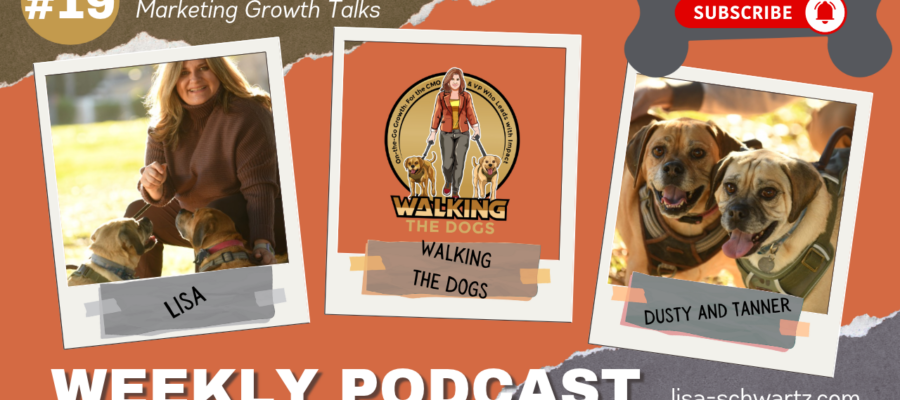
I can say exactly the same thing to Dusty and Tanner and get two completely different reactions. “Let’s go.” Dusty hears an invitation to investigate every tree in the neighborhood. Tanner hears an opportunity to supervise the entire street. Both dogs are ready to move, but their motivations could not be more different.
B2B buying groups behave much the same way. A CFO, a controller, an IT leader, and the person who processes invoices may all be considering the same software. They are not listening for the same thing. Each is asking a different question about what will improve, what might go wrong, and whether your company can deliver. In Episode 19 of Walking the Dogs, I explore how to build a B2B messaging architecture that respects those differences without turning your positioning into four separate stories.
From Reframe to Orchestrate: Make the Strategy Usable
My GROWTH Framework is designed to turn growth thinking into coordinated action. In Gauge, we examine the business, the market, and the gaps standing in the way of growth. In Reframe, we decide which customers to pursue, which outcomes matter, and why our offering deserves attention.
Then we arrive at Orchestrate. The work becomes less about deciding what the strategy is and more about helping the company execute it together. Marketing, product, sales, customer success, and the systems supporting them need a common way to explain the value customers should expect. A positioning statement trapped in a presentation cannot do that job on its own. Your team needs a practical set of messages, evidence, objections, and guidelines that travel with the buyer from the first website visit through implementation.
Start With a Business Problem You Can Own
Imagine a software company helping finance teams reduce manual work. Its homepage could lead with “our revolutionary AI platform.” That tells me what the company wants to call itself. It does very little to tell a buyer why they should care.
I would rather start at a whiteboard with the business problem: Finance workload is growing faster than the team’s capacity. Then I would write a simple central promise below it: Handle more finance work with greater control and less manual effort.
Now we have something specific enough to evaluate. Can the product support it? Can a salesperson explain it? Can customer success recognize it in the customer’s actual experience? Are there implementation requirements that would qualify the claim? If the product needs six months of implementation and three additional administrators, “less effort” needs careful explanation. The promise has to survive contact with reality.
One Promise, Four Different Sets of Ears
Here is where the work gets interesting. The company keeps its central promise, but the conversation and proof change depending on who is listening.
🐕 The CFO wants to know whether the business can manage costs as it scales. Give this person an economic case, the assumptions behind expected savings, and a credible picture of financial impact.
🐕 The controller wants a faster close and fewer exceptions. Show how unusual invoices, approvals, and errors are handled, not just an ideal workflow demo.
🐕 The daily invoice processor wants to stop chasing missing information. Show what changes on a normal Tuesday, including the tasks the person will still own.
🐕 The IT leader needs clarity on security, integration, and maintenance. Show the architecture, the dependencies, and who is responsible for what.
These are not four unrelated value propositions. They are four interpretations of the same promise, each backed by evidence relevant to that person’s decision. The distinction matters. If every persona gets a different headline without a shared foundation, your message fractures. If everyone gets identical copy, you leave each buyer to translate the value on their own.
Walk the Message Around the Buying Journey
Messaging also needs to change as the customer moves closer to a decision. At the problem-recognition stage, a finance leader may need help quantifying the cost of manual approvals, rework, and delays. During evaluation, the buying group needs to compare approaches and see how your product handles the work. Before approval, the customer needs a realistic business case, an implementation picture, and confidence that risks are understood. After purchase, the team needs to see the promised value appearing in onboarding, adoption, and business reviews.
Look at those interactions from the buyer’s point of view. If your homepage promises operational control, your sales demo focuses only on AI features, and onboarding talks only about configuration tasks, the customer is forced to reconnect the dots. That is a lot to ask of someone who has other things to do. Good messaging architecture creates continuity. It helps each customer conversation pick up where the previous one left off.
Subscribe for more resources on this topic here
Make It a Real Walk Around the Whiteboard
When I say “let’s walk the dog,” I mean getting people together to work through a problem in the open. I start with what I know, put the rough thinking on a whiteboard, and invite the team to improve it. By the end, we should have a more useful map and real assignments, not just a lively conversation.
For this messaging walk, I would bring together product marketing, sales, customer success, and someone who speaks with customers regularly. We would write the business problem and central promise at the top of the board. Then, for each buying-group member, we would answer four questions: What are they trying to accomplish? What gets in their way? What would make them believe us? What might make them say no?
Next, we would test our answers against actual buyer conversations. Ask a salesperson to explain the promise the way a recent prospect described it. Ask customer success whether customers recognize the value in those terms. Ask product where the message needs a qualifier. A phrase that sounds terrific in marketing but falls apart in a customer meeting is not ready. The group should leave with a working hierarchy: the core problem, a single promise, persona-specific concerns, approved proof, likely objections, and a map of where each message belongs in the journey.
Give AI the Architecture, Not Just a Brand Voice
AI content assistants can make variations of messages quickly. That makes the structure even more important. A tone-of-voice document may tell an assistant to sound confident, clear, and practical. It will not tell the assistant which claims are approved, which buyer needs which evidence, or where the product has limitations.
An assistant helping draft a CFO email should know the economic case and its assumptions. An assistant helping with an IT brief should know which integration facts are verified. Neither should casually turn an estimate into a guarantee or invent an implementation outcome.
The customer problem, central promise, approved proof, persona concerns, and claim boundaries belong in shared context. Someone also needs to own updates as the product and evidence change. Otherwise, the team can produce inconsistent messaging faster than ever.
Bring the Dog Home: Assign the Work
A good whiteboard session has a next step. Before we leave, someone owns the missing implementation evidence. Someone updates the business case. Someone reviews onboarding to make sure it reinforces the promise. Someone decides where the approved messaging will live and who can change it. I put my own name beside an assignment, too.
That is the point of walking the dog. We go from incomplete thinking to a clearer route, and then take responsibility for the next block. The meeting is not the finish line. The follow-through is.
Here is a simple exercise for this week: follow one promise from your homepage to a sales conversation, into a product demonstration, and through onboarding. Listen for the words people use and compare the evidence they offer. Does the same promise survive the trip?
Dusty and Tanner will always hear “let’s go” differently. I do not need them to have identical motivations. I need both dogs to know which way we are heading. That is what a useful messaging architecture does for a business.
This is Episode 19 of Walking the Dogs, part of the Orchestrate series in my GROWTH Framework. What promise would you put at the top of your whiteboard?