If nobody owns what happens between marketing, sales, and customer success, your buyer gets to manage the handoffs.
They repeat their priorities. Explain what they already watched. Remind someone what was promised. Then wait while your teams catch up.
B2B funnel orchestration means deciding how teams act together as a buyer becomes a customer: what signals matter, who takes the next action, what information travels with them, and what happens when progress stalls.
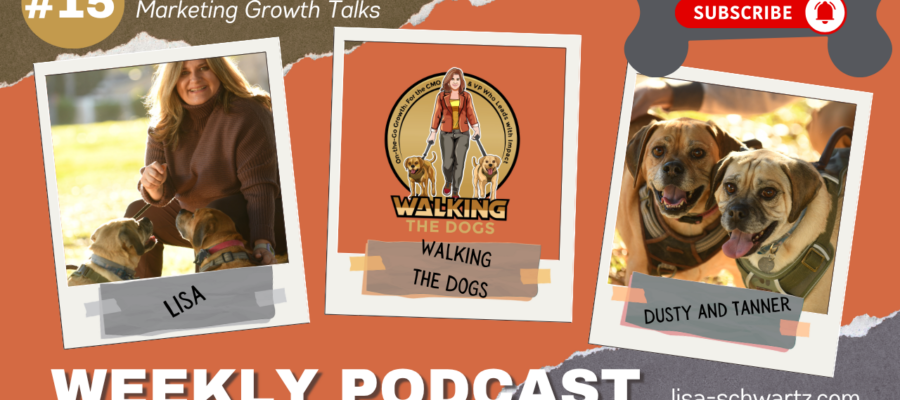
That is what we’re walking through in Episode 15 of Walking the Dogs, “Walking in Sync: Orchestration Across the Funnel.”
It’s Lisa, out with Dusty and Tanner. And every so often, something almost magical happens. They walk at the same speed, in the same direction, without crossing in front of me or wrapping a leash around my legs.
For about forty-five seconds, we look extremely professional.
Keeping that going requires considerably more coordination than either dog seems interested in providing.
Companies can be surprisingly similar.
Subscribe for more resources on this topic here
Good teams can still deliver a fragmented experience
Imagine a CIO from one of your target accounts attends an executive webinar. Marketing records the engagement and passes the lead to sales three days later.
The rep sees a name, a title, and a company. They don’t know which discussion caught the CIO’s attention or what question the CIO asked.
So the rep sends: “I’d love to introduce our company.”
That buyer has already been introduced. They gave you their time and some context. Your follow-up should reflect both.
Now consider the other end of the funnel. Sales closes a deal around three specific use cases. Customer success receives an account record that says “Closed won” and schedules a discovery conversation.
The customer gets to explain those three use cases again.
Each department may have completed its assigned task. The experience still feels disconnected because the information needed for the next step never arrived.
Dusty can make excellent progress toward a tree while Tanner makes excellent progress toward another dog. My arms will confirm that individual progress does not guarantee a coordinated walk.
Why this belongs in Reframe
My Growth Framework moves through Gauge, Reframe, Orchestrate, Work the Plan, Tune, and Harvest.
Gauge helps us understand what is happening and where growth is getting stuck. Reframe establishes the choices that shape what happens next: the outcome we want, the customers we need to win, the motions we will support, and the resources required.
Before moving into Orchestrate, we need to agree on how those choices connect across the customer journey.
If expansion ARR is our North Star, that decision needs to influence more than a leadership presentation. It should shape customer marketing, product adoption, sales conversations, and customer-success priorities.
Otherwise, we have agreed on a destination without agreeing on how to get there together.
Vertical alignment connects the work to the business outcome
Vertical alignment connects the business goal to campaigns, seller actions, and customer outcomes.
Take expansion ARR. Marketing might help existing customers understand an additional use case. Customer success might identify whether the customer has achieved value from the original purchase. Product adoption information might help the team decide whether an expansion conversation is timely.
Sales then needs that context before making an offer.
The question for every activity becomes: How does this help the customer move toward the outcome that supports our growth goal?
That question gets uncomfortable when a team’s dashboard rewards work that has little connection to the agreed priority. It is also exactly why the conversation belongs in Reframe.
You want to resolve those competing directions before everyone picks up speed.
Horizontal alignment connects the teams
Horizontal alignment defines what happens when responsibility moves from one team to another.
Marketing to sales. Sales to customer success. Product to marketing. RevOps helping connect the information and processes across them.
“Sales will follow up” leaves a lot unresolved. Who follows up? With what context? By when? What happens if the buyer does not respond?
The same applies after a deal closes. A useful handoff should carry the buyer’s goals, the use cases discussed, and the commitments that will shape onboarding.
Your customer should feel the benefit of everything they have already told you.
Walk one buyer journey around the whiteboard
When I say, “Let’s walk the dog,” I mean putting an incomplete idea in front of the team and working through it together until we have an informed plan and assigned actions.
For this exercise, choose one important buyer journey. An executive webinar attendee moving into a sales conversation is a good example. So is a new customer moving from purchase into onboarding.
Draw the journey on the whiteboard. Then work through these questions at each stage:
- 🐕 What is the buyer trying to accomplish? Describe their goal in language they would recognize.
- 🐕 What signal tells us they moved? Identify the behavior that warrants a different response.
- 🐕 Who owns the next action? Name the responsible person or role.
- 🐕 What information must travel with them? Include relevant interests, questions, use cases, and commitments.
- 🐕 How quickly must the handoff happen? Agree on a timeframe the team can support.
- 🐕 What happens if they don’t move? Define the follow-up, return to nurture, or reassessment.
Then look for the awkward moments. Where does the buyer repeat themselves? Where do two teams act at once? Where does everyone assume someone else is handling it?
Those are the places to work on first.
Turn several signals into one coordinated response
Imagine a target account downloads a technical guide, attends a webinar, and then visits your pricing page.
You now have a sequence of behaviors that deserves consideration together. Sending three unrelated emails and adding a generic SDR call gives the buyer very little evidence that you noticed.
A coordinated play could work like this:
- 🐕 Marketing pauses generic nurture while the account receives focused follow-up.
- 🐕 Sales receives the engagement context, including the content and topic that prompted interest.
- 🐕 The outreach connects to that interest, supported by a relevant case study.
- 🐕 The team agrees on a fallback. In this example, no response after seven days sends the account back to an appropriate nurture path.
Seven days is an example to agree on for that play. The essential decision is what happens next and who owns it.
The sequence should make sense from the buyer’s side. They explored a topic, showed additional interest, and received a relevant response.
Finish the exercise with assignments
A productive whiteboard conversation still needs a way to leave the room.
Capture the handoff gaps, assign an owner to each change, and set a date to review whether the agreed actions are happening. Include your own commitments.
That is part of walking the dog, too. The thinking becomes useful when someone takes responsibility for bringing it home.
You do not need to redesign every journey at once. Start with one transition where context regularly disappears or ownership becomes unclear. Make that transition explicit, then work through the next one.
A funnel diagram becomes operational when people know what to do with the next buyer signal.
Dusty and Tanner can both walk beautifully on their own. Getting us home together requires coordination at every turn.
Pick one journey. Find the tangled leashes. Agree on who does what next.
Dog walked.
Watch Episode 15 of Walking the Dogs: Walking in Sync: Orchestration Across the Funnel. https://youtu.be/Emubl7nd6YY
Next time, we finish Reframe by asking which business outcome AI should own.
What dog do you need to walk today? Don’t forget the poop bags!