A lot of ABM programs are really just advertising campaigns with a target-account list attached. Real ABM is harder. It requires marketing and sales to operate around the same accounts, the same customer journey and the same definition of progress. The HP Z Data Science campaign is one of the clearest examples from my career of what that orchestration can look like.
Start with the accounts
The program was built around 2,441 high-propensity named accounts. Not a giant anonymous universe. Named accounts. Data Science end users. IT decision-makers. And an end-to-end marketing and sales journey.
The planning deck actually used the phrase CUSTOMER JOURNEY IS KING. That wasn’t decoration. It shaped the operating model.
Build the system around the journey
The campaign integrated journey-based content development, media informed by the customer journey, account propensity scoring and selection, Eloqua throughout the journey, personalized HP.com experiences through AEM and Adobe Target, account engagement dashboards, campaign performance dashboards, and sales engagement driven by the journey.
That’s what I mean by Orchestrate in my Growth Framework. The components weren’t independent tactics. They were parts of one system.
The results started showing up at the account level
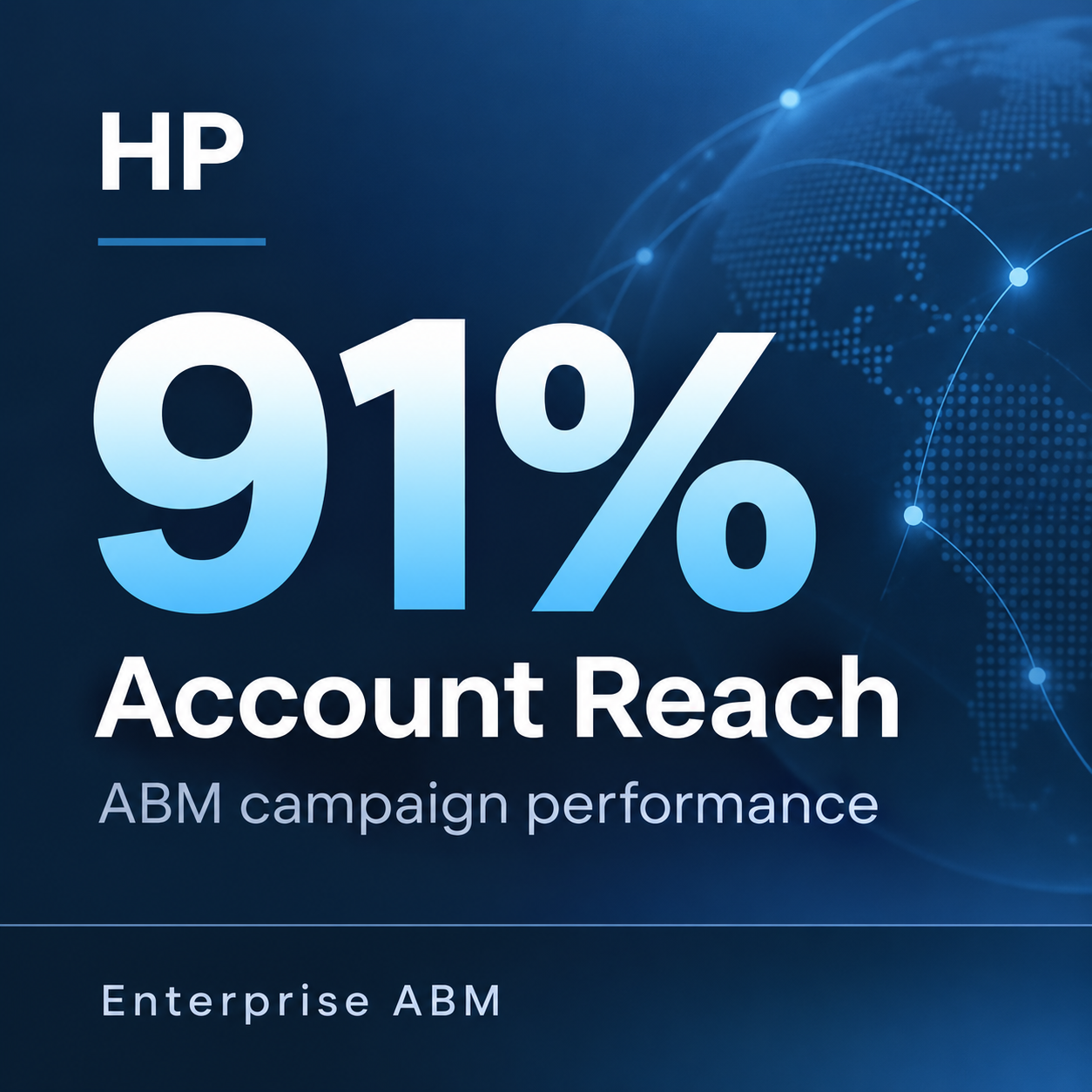
Initial reporting showed 91% account reach, 297 accounts visiting HP.com, 65 accounts engaging with campaign content, 185 total form fills, and approximately $800,000 in opportunities from five of the top ten engagement accounts. Email open rates were also reported at roughly 2X the benchmark, and the program reached more than 26,000 HP.com visits, including approximately 18,000 unique visitors.
But again, the most important number isn’t necessarily the biggest number. It’s the relationship between the numbers: accounts targeted, accounts reached, accounts landed, accounts engaged, forms submitted and opportunities created. That’s an account journey.
Orchestration beats channel management
A traditional marketing organization might have an email team, a media team, a website team, an events team and sales, everybody hitting their own KPI. The buyer experiences none of those departments. They experience one company.
That’s why the HP campaign’s customer-journey orientation mattered. Awareness content led to consideration. Consideration led to evaluation. Evaluation connected to product information and sales. Non-responders could be retargeted. Known accounts could receive personalized experiences. Sales could use engagement as a signal. That’s not a media plan. That’s orchestration.
Tanner would absolutely complicate this
If you’ve listened to Walking the Dogs, you know Tanner. Tanner’s specialty is discovering an alternative route approximately every 90 seconds. That is what customer journeys actually look like.
Buyers don’t move from ad to landing page to form to sales to closed-won in a straight line. They wander. They read something, disappear, come back through search, attend an event, talk to a colleague, visit the product page, ignore three emails, then suddenly fill out a form.
Our job isn’t to force the buyer into our org chart. Our job is to orchestrate enough connected experiences that they can keep moving.
What ABM should actually mean
ABM isn’t show ads to big companies. It is choose the accounts that matter, understand the buying committee, create the right journey, coordinate sales and marketing around that journey, and measure movement at the account level.
That is much harder. It’s also why it works.
Growth Framework connection: Orchestrate -> Work the Plan -> Tune.
Walking the Dogs connection: The buyer doesn’t walk a perfectly straight path, so the growth system has to accommodate multiple routes to the same destination.
These posts are part of the Growth in Practice series.
These five cases span very different companies, markets and stages of growth. But the pattern is remarkably consistent. Gauge reality. Reframe the market and goal. Orchestrate the buying journey. Work the Plan. Tune to market behavior. Harvest what works into a repeatable growth system. That is my G-R-O-W-T-H Framework.